
Top 10 Big Yields Ranked: BDCs, CEFs & More

If you are paying attention to the mainstream media, you might think investing 100% of your wealth into volatile AI growth stocks is the right thing to do. But with the growing headwinds of rising interest rates, combined with the uncertainty of the upcoming November midterm elections, a healthy allocation to income-focused investments can make a lot of sense. What’s more, if you know where to look, there are a variety of particularly compelling income opportunities right now. This report ranks our top big yielders (including BDCs, CEFs and more), starting with #10, and counting down to our very top ideas.
A Quick Note on Interest Rates
You may have noticed that the yield on long-dated (30-year) treasury bonds just crossed 5% for the first time since 2007. This can create profound headwinds for the US economy, ranging from higher debt-servicing costs on the US government (i.e. we the taxpayers will now pay a lot more money (interest) to support the government’s massive debt).
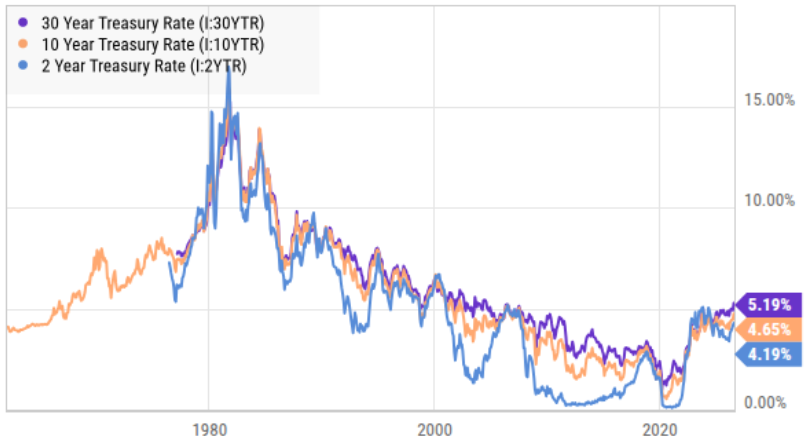
And higher interest rates can also slow the rate of disruptive economic growth because it will now cost more for those disruptive AI stocks to borrow money (to finance their low and/or zero-profit businesses).
Further still, rising rates makes it more expensive for consumers to purchase homes, finance new cars, and thereby reduces their spending power in general—yuck!
Lastly, when rates rise, bond prices fall (all else equal), and that has created some interesting lower entry-point prices on select big yield investments, such as bond closed-end funds (“CEFs”), Business Development Companies (“BDCs”), and more.
So with that backdrop in mind, and without further ado, let’s get into the top 10 big-yield rankings, starting with #10 and counting down to our very top ideas.
10) PIMCO Corporate & Income Opportunities (PTY), Yield: 12.2%

Coming in at number 10 is a popular big yielder from premier bond fund manager, PIMCO. This particular closed-end fund offers diversified exposure to various fixed-income markets, and is currently trading at a much smaller premium to NAV than normal (see chart below, including the negative z-scores—an indication of lower prices versus net asset value as per recent history).
data as of Friday’s close 8/21 (or most recent available).
Investors have widely different views on the premium and discount levels from PIMCO funds, ranging from premiums are bad (why would you pay more than the holdings are worth) to premiums are good (PIMCO’s active management is worth it, and a premium can help support the large distributions because it allows PIMCO to issue more shares in the open market at a price above the cost to create them). With regards to PTY, the premium is currently a lot smaller than it has been, the distribution coverage ratio is currently better than many other PIMCO funds, and you can read our full report on PTY here.

9) Main Street Capital (MAIN), Yield: 7.5%
Switching gears to a business development company, or BDC, Main Street Capital is often scoffed at because the yield is lower than other BDCs and its price to book value is often higher than its BDC peers.
However, what a lot of investors fail to realize is that Main Street has a dramatically better track record of increasing its net asset value (and share price) over time (while competitors stay flat or even decline). And if the share price appreciation plus big steady dividends are not enough, Main Street also occasionally pays additional special distributions. Plus, Main Street is internally managed (a characteristic many investors appreciate because it can reduce management conflicts of interest. Overall, Main Street has been delivering big steady income for many years, and it is positioned to continue delivering in the future.
8) Cohen & Steers Quality Income Realty (RQI), Yield: 8.8%

Real Estate has been out of favor for years, as work-from-home and shop-on-line has exploded thereby putting pressure on certain real estate sub-industries and on the group as a whole.
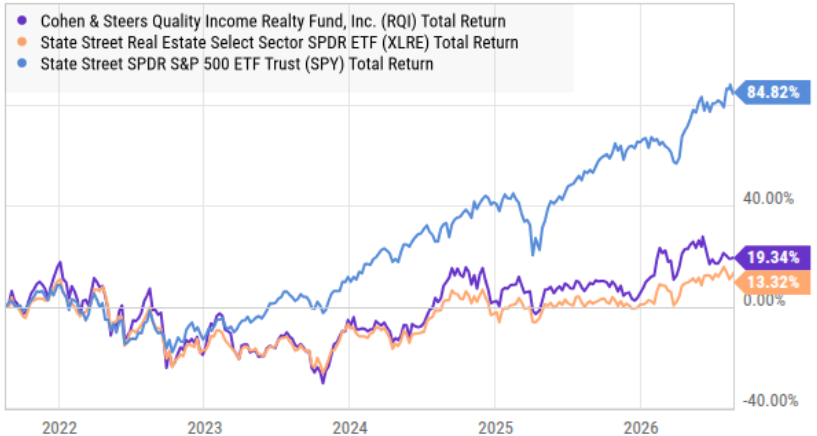
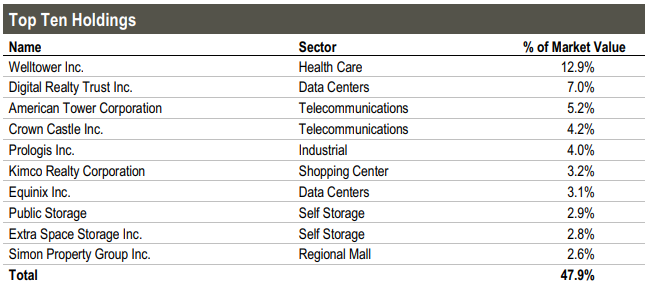
However, after years of underperformance for the sector, this fund is positioned to perform well (top holdings include REITs with exposure to attractive data center real estate, industrial properties and even attractive deep value plays that are due from some contrarian strength), not to mention RQI trades at a compelling discount to NAV in recent months, thereby creating a much more attractive entry point.
It uses some leverage (recently 26%) to magnify returns and income from this lower-beta market sector, and it also pays monthly (attractive). If you are looking for some diversification and an attractive contrarian opportunity, RQI is absolutely worth considering.

7) BlackRock Multi-Sector Income Trust (BIT), Yield: 12.4%
PIMCO is not the only big-yield bond CEF manager on the planet, and BlackRock has deep resources and capabilities too—not to mention the funds are often more conservative in their implementation and they often trade at deeper discounts to NAV too.
| Ticker | Yield | Disc/Prem | Leverage | Price % of 52W Avg |
Chart | Mkt Cap | Freq | Strategy | ZScore 1Yr |
ZScore 3M |
ZScore 6M |
|---|
For example, BlackRock’s Multi-Sector Income Fund (BIT) offers a healthy 12.5% yield, paid monthly, and it currently trades at a 9.2% discount to NAV (a significantly larger discount than normal as per the z-scores as you can see in the table below).
6) Adams Diversified Equity Fund (ADX), Yield: 8%+
The Adams Diversified Equity Fund has been paying big distributions for over 85 years, and it gives income-focused investors a chance to invest in diversified equity markets too (including a lot of the high-growth technology industries that many income-focused investors often miss out on).
A few things to keep in mind, ADX generally doesn’t use any leverage (equity markets provide plenty of volatility and growth without layering on the leverage that bond funds often use), it pays distributions quarterly (typically smaller in quarters one, two and three, followed by a larger fourth quarter distribution that brings the yield to at least 8% for the year, and sometimes more). And ADX trades at a small discount to NAV (attractive!). If you are looking for a diversified source of higher income—this one is absolutely worth considering for a spot in your diversified income-focused portfolio. You can read our previous ADX report here.
The Top 5 Big Yields
The top 5 big yields are available to members only, and they can be accessed here. I currently own 4 of the top 5 (in the Blue Harbinger High-Yield Portfolio, and may add the 5th very soon. Enjoy!
The Bottom Line:
Big-yield investments are tempting as a way to take your foot of the typical stock market gas pedal that the pundits keeps pressuring you to go all in on (such as aggressive growth AI stocks). Diversifying into high income can be a smart move, just know that big-yield investments come with risks of their own, and it is important to diversify across big-yield categories (such as those in this report), and across balanced high-income opportunities in general (as we wrote about here).
And for your reference, you can view the entire Blue Harbinger High Income Portfolio here: