
PTY: 10 Top Big-Yield PIMCO CEFs (Warsh Vs. Bessent)
If you are an income-focused investor, there is an entire universe of big-yield opportunities out there, besides simply PIMCO bond CEFs. But considering PIMCO is the premier bond fund manager in the world, and the company offers so many big yield CEFs to choose from, this report compares and contrasts them--into 10+ different categories--with a special focus on PTY (including a review of its objectives, distribution safety, risks, unusually small premium to NAV, and more) combined with the latest policy divergence between Kevin Warsh at the Fed and Scott Bessent at the Treasury (they are whipsawing long-dated bond yields, and creating some unusual CEF price discounts versus net asset value (“NAV”)). This report concludes with a strong opinion about investing in PTY and PIMCO's big-yield bond CEFs in general.
Overview: Report Card Day
For starters, here is a look at 10 top big-yield bond CEFs from PIMCO, ranked by 10+ different important categories.
As you can see in the table, the distribution yields are huge (but in some cases not well covered), and the typically large price premiums (versus NAV) have all but evaporated (thanks in part to the latest clash between US Treasury Secretary Scott Bessent and Fed Chair Kevin Warsh) as measured by z-scores (negative numbers are an indication that the prices are lower than recent history as compared to NAVs. We’ll refer back to this table throughout the article.
7 Big-Yield CEF Questions
And before getting into the details of PTY in particular (and the details on Warsh versus Bessent), it’s worth considering some basic due diligence questions I always ask myself before investing in any big-yield CEF.
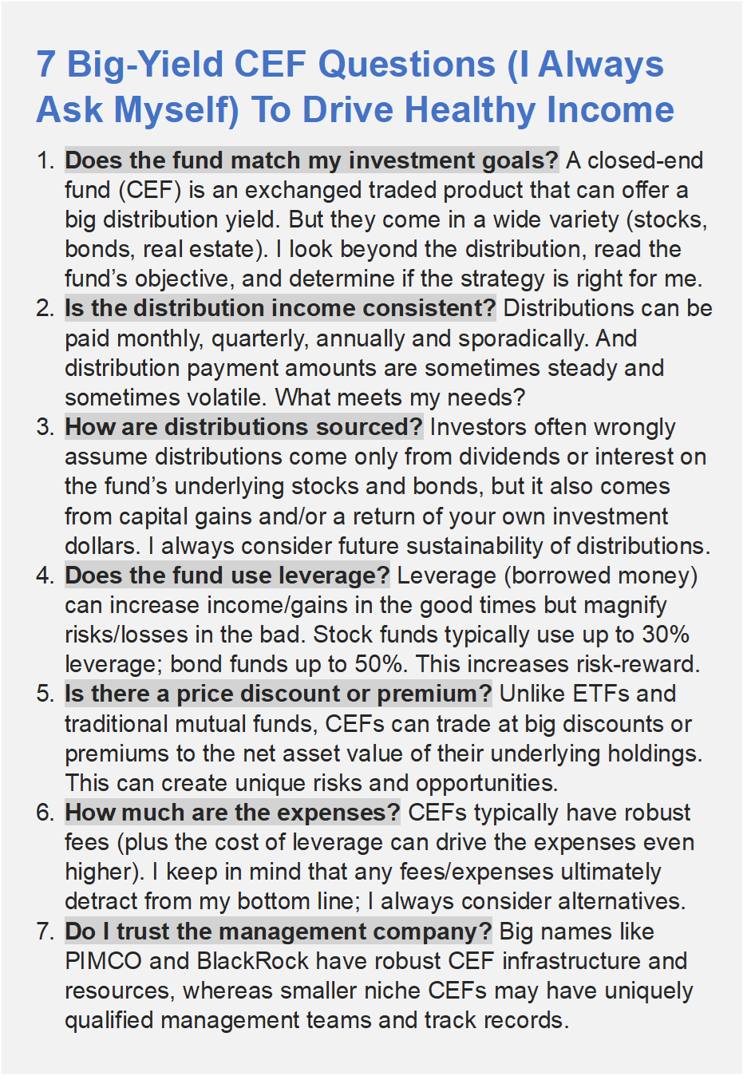
Specifically, the questions in the graphic (above) will also help guide the review of PTY and the current state of the big-yield CEF market.
PIMCO Corporate & Income Opportunity Fund (PTY), Yield: 12.2%
PTY is the second largest of the PIMCO big-yield bond CEFs in our earlier table, and it is particularly interesting right now because it is still hanging on to a small premium verusus NAV. Many longstanding PIMCO CEF premiums have evaporated and even turned negative (to discounts) over the last week as the US Fed versus Treasury dynamics have played out (more on this later). And the smaller premium on PTY (and new discounts on other funds) is particularly attractive to a lot of income investors who like to buy low.
PTY’s Objective: According to PIMCO, PTY “seeks maximum total return through a combination of current income and capital appreciation.” This is somewhat unique versus other PIMCO CEFs which emphasize income as the primary objective and capital appreciation as a secondary objective. And to accomplish its objective, PTY uses “a dynamic asset allocation strategy that focuses on duration management, credit quality analysis, risk management techniques, and broad diversification among issuers, industries and sectors.”
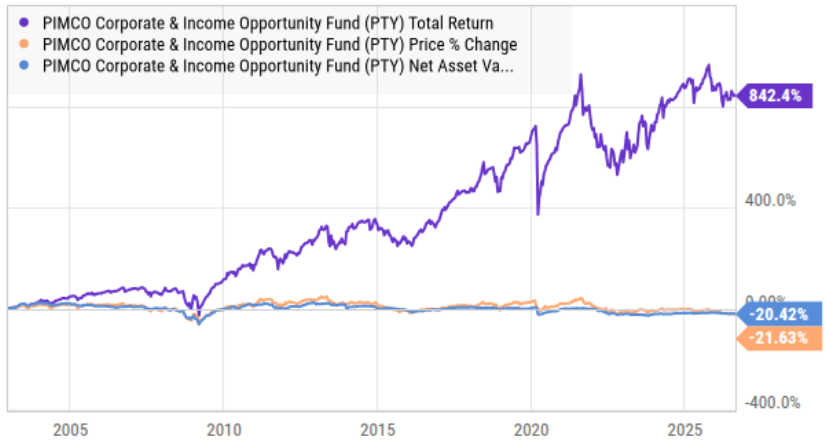
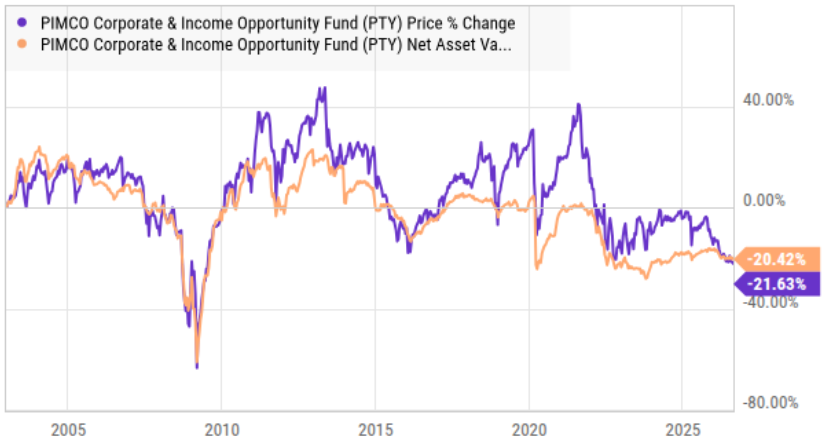
And as you can see in the graphic above, PTY has delivered on its objective over time (i.e. the total return has been impressive). And for good measure, you can get an idea of the historical premium/discount versus NAV for PTY in the following chart too.
PTY’s Distribution: One of the first things many income investors notice about PTY is that it has a very long history of delivering big monthly income, plus some historical special distributions too, as you can see in the chart below.
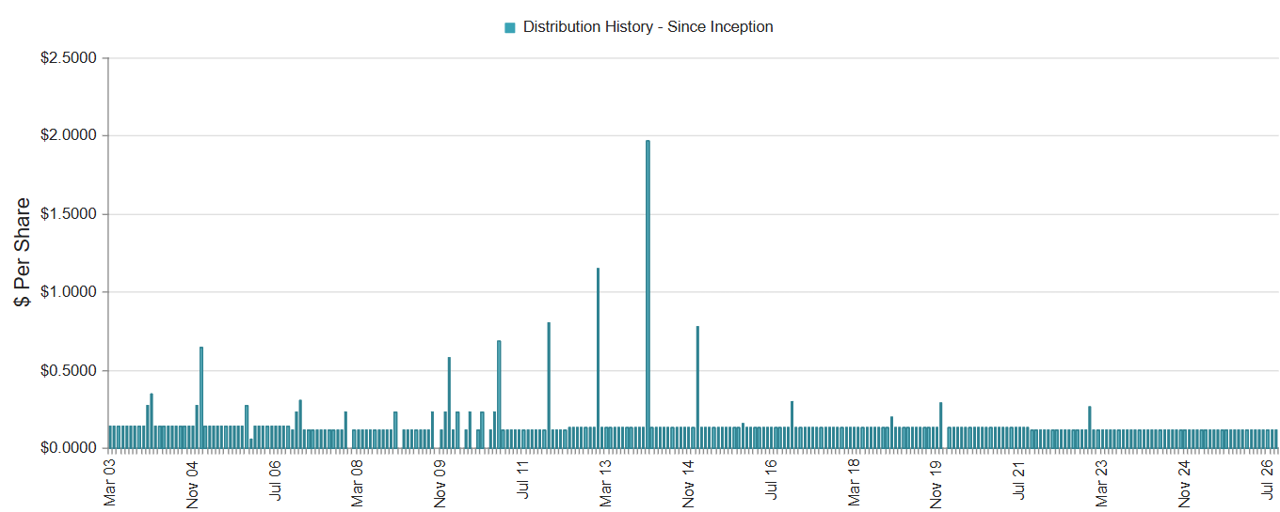
And on top of this impressive long-term track record, PTY’s distribution coverage ratio (as you can see in our earlier report card table) over the last six months is not perfect at 94.9%, but it’s a lot stronger than many of its peers. This is also fairly consistent with the long-term price declines we saw in the earlier graph, even though the total returns have been extremely positive over the long term (total returns are basically price returns plus distributions as if they were reinvested).
So if you are looking for the distribution goods, PTY has largely delivered over time.
PTY’s Leverage: PTY also uses relatively conservative leverage, or borrowed money (recently 17.9%), to magnify its returns and income, and as compared to other PIMCO CEF strategies (see earlier report card table). A lot of investors appreciate this less aggressive approach considering it also keeps expenses lower. Specifically, PTY’s total expense ratio is significantly lower than other PIMCO CEFs because it uses less leverage and the interest paid on borrowed money quickly adds significantly to total expenses (especially on CEFs that use more leverage).
PTY’s Premium to NAV: PTY’s premium to NAV is significantly smaller than normal, and this creates a more attractive entry point for investors, especially if the larger premium returns in the future (an increasing premium adds to investor price returns, and it also allows PIMCO to issue more shares at an immediately accretive value that helps strengthen the distribution payout).
PTY’s Expenses: As mentioned, PTY’s expense ratio is lower than peers because it uses less leverage. And depending on your goals and situation, this is one particularly attractive characteristic to a lot of investors.
PTY’s Big Risks: Of course PTY does face big risks, beyond simply the leverage, the premium-discount dynamic and the expenses. For example, PTY faces interest rate risk, recently 4.8 years as measured by duration in our earlier report card table. This is fairly consistent with other PIMCO CEFs. And it gives a relative ideas of how much rising rates will impact the price of PTY (when rates rise, bond prices fall, all else equal).
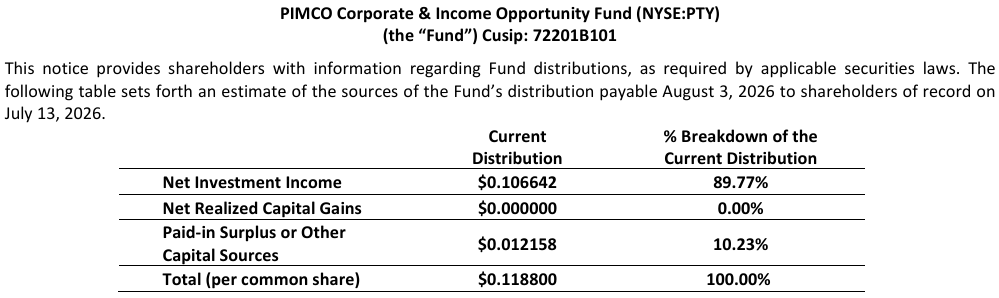
PTY also has a fair amount of Paid-in Surplus or Other Capital Sources, as you can see in our earlier table. According the PIMCO, PISOCS can be economically similar to a “Return of Capital” which some investors loathe (returning capital can reduce NAV, which reduces a fund’s power to generate income to support its distributions. However, a little PISOCS from time-to-time isn’t the end of the world (especially if it helps maintain the distribution), and PTY’s PISOCS is lower than a lot of other PIMCO funds.
Kevin Warsh versus Scott Bessent
Interest rate risk is one of the risks we covered above, and it is particularly important as long-dated US treasury bonds have continued to experience interest rate increases recently, despite divergent treasury bond purchases (or lack thereof) by Kevin Warsh (the head of the Federal Reserve) and Scott Bessent (US Treasury Secretary) over the last week.
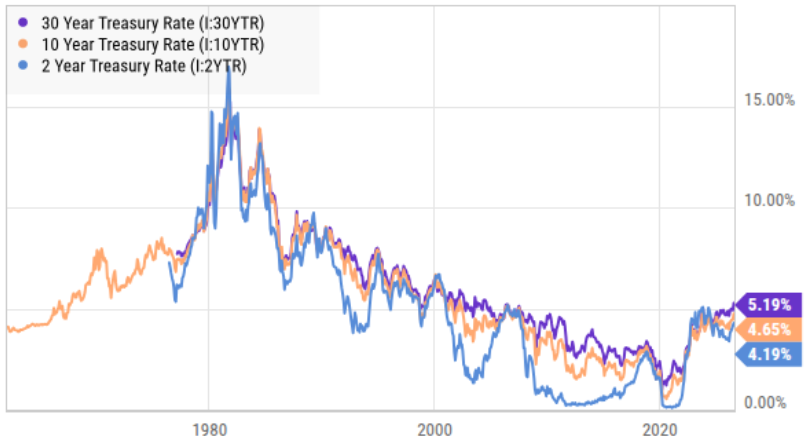
For starters, the yield on 30-year treasury bonds just recently pushed above 5%—its highest level since 2007. This basically means bond investors are demanding more payment for taking on US government bond risk—a fairly clear warning that investors are concerned about government debt and spending levels (especially as we head into the US midterm elections at the start of November). And US government debt becomes an even bigger problem (more expensive) as yields rise—yuck!
But here is the interesting part. The US treasury department (under secretary Scott Bessent) just reacted to long-dated bond rates rising by announcing it would double treasury buyback operations to at least $4 billion starting September 9th through November 4th—the day AFTER the midterm elections. This move seems both economically and politically significant (although the amount isn’t too significant (yet) relative to the roughly $30 trillion treasury market).
However, compounding the situation, relatively new chairman of the Federal Reserve, Kevin Warsh, is reluctant to also purchase treasuries through the open market (which has been a customary complement to Treasury efforts in the post ‘08-’09 GFC era) because he leans more towards free markets and less government intervention (especially considering such intervention may be perceived as more of a temporary band-aid instead of an actual long-term fix—which it is a band-aid—but I digress).
So when Bessent announced treasury buybacks—yields fell, but when Warsh didn’t reciprocate—yields went right back up to where they were. This uncertainly, combined with higher rates, creates fear/volatility in the bond markets and it is part of the reason PIMCO bond CEFs have sold off recently (as rates rise, bond prices fall, all else equal).
However, CEFs are a particularly interesting case because they don’t necessarily trade at NAV (they trade based on supply and demand) and so selling pressure (fear) has contributed to the shrinking and even disappearance of many long-standing PIMCO CEF premiums over the last week.
So what does all of this mean?
The Bottom Line:
Considering PIMCO is the premier bond fund manager in the world, and its CEFs often trade at large premiums to NAV, the recent selloff is compelling to many investors because it creates an opportunity to both buy at a lower NAV (which can mean higher yield) and an opportunity to buy without the typical big price premium (also arguably quite attractive).
And among PIMCO CEFs, PTY is particularly compelling because its yield is big and it has significantly better coverage than many others. Not to mention it has an impressive long-term track record, more conservative leverage, and lower fees.
Just know there are risks. For example, rising interest rates to fight Covid-induced inflation is what led a lot of PIMCO CEFs to decline sharply in value several years ago. And while currently rising rates create challenges, it’s important to note that rates are currently rising at a much slower trajectory than the unprecedented pace following Covid.
Further, there is a wide variety of other big-yield opportunities out there (besides simply PIMCO CEFs) for income-focused investors to choose from.
So if you are considering an allocation to PIMCO CEFs, particularly PTY, the recent price and NAV action creates some particularly attractive entry points versus a lot of other times throughout history.
Said differently, if you are an income-focused investor, PTY is absolutely worth considering for one spot in your disciplined, prudently-diversified, long-term, income-focused portfolio.