
A fearful narrative about Broadcom's software business (VMware) was already inappropriately holding the share price of this AI chipmaker too low. And now the accelerated post-election AI-selloff has turned the shares into an absolute gift for long-term investors. After reviewing the powerful business growth trajectory, this report considers the valuation and risks before finally concluding with a strong opinion on investing in Broadcom, and other top AI chipmakers, at this point in the market cycle.

About Broadcom (AVGO)
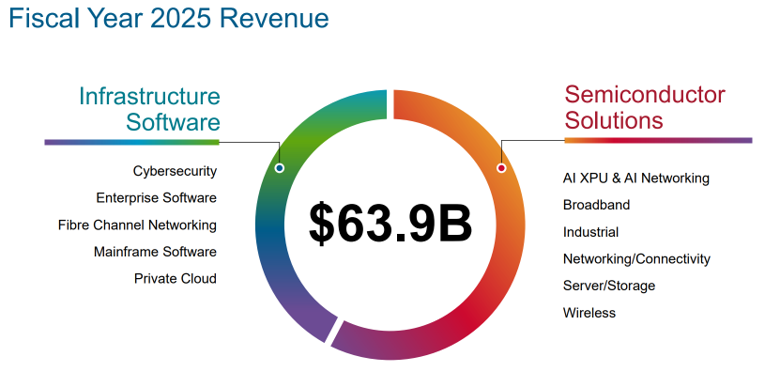
As you can see in the graphic below, Broadcom operates in two main segments: (1) semiconductor solutions and (2) infrastructure software. Its semiconductor business includes AI accelerators, network connectivity, and other datacenter components. Its software division includes VMware (a private-cloud virtualization platform—and large 2023 acquisition) plus mainframe software, cybersecurity, and other enterprise software.
Last quarter (Q3-26), semiconductors generated $20.8 billion, or 70% of total revenue, while infrastructure software contributed $8.8 billion, or 30% of total revenue.
And important to note, Broadcom’s infrastructure software segment generates substantially higher operating margins than its semiconductor business (typical for software), thereby making VMware a particularly valuable contributor to the company’s overall profitability and recurring cash flow (more on this later).
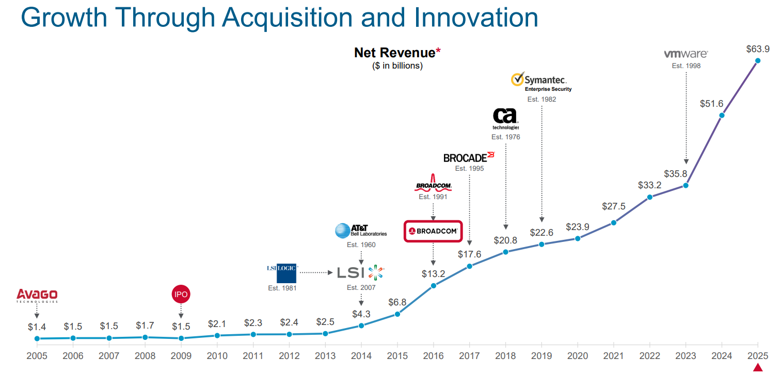
Booming AI Growth
Before getting into the narratives holding Broadcom shares back, its important to consider the company's powerful AI growth trajectory. Specifically, Broadcom's AI opportunity is extraordinary.
For example, Broadcom's third-quarter AI semiconductor revenue reached $16.7 billion, increasing 221% year over year. And management forecasts $58 billion in fiscal 2026 AI revenue, followed by $115 billion in 2027 and $230 billion in 2028. This is a lot of revenue growth.
Also important to note, Broadcom’s competitive advantages include a long-standing Google (GOOGL) TPU relationships and expanding OpenAI and Anthropic engagements—thereby providing significant growth opportunities.
Also, Q3 free cash flow reached $13.7 billion, demonstrating serious financial horsepower supporting the impressive growth.
Fearful Narrative #1: AI Will Eat Software
Broadcom shares have significantly underperformed the broader semiconductor space over the last year—by a wide margin.
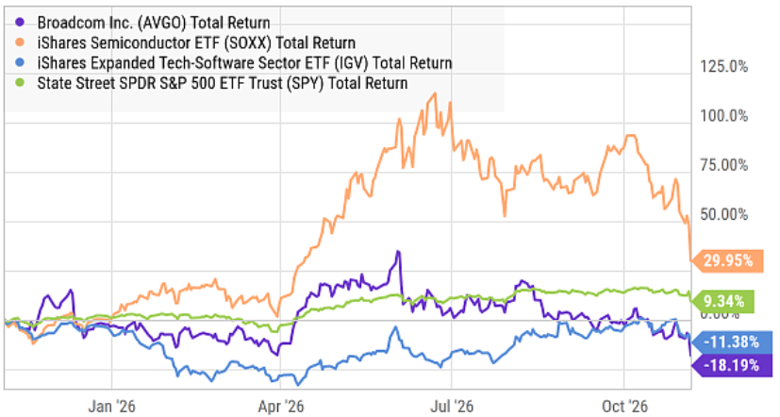
And a big part of the story over the last year is simply that investors have increasingly favored semiconductor exposure (SOXX) while selling software businesses (IGV) due to fear of AI disruption. The oversimplified narrative driving near-term market prices has been that that AI makes software creation so simple that all existing software businesses are sitting ducks (which isn't necessarily true).
As such, Broadcom sits in an odd place due to large businesses in both AI semiconductors and software—largely VMware.
However, treating Broadcom’s large software portfolio as simply an AI casualty overlooks its powerful margins and growth. For example, Broadcom’s infrastructure software revenue grew 29% year over year (this is a lot). And with $8.8B in segment revenue and only $508M in segment cost of revenue, that's an impressive 94%+ margin.
Not to mention VMware's mission-critical infrastructure role for large enterprises operating private clouds and new AI workload deployments.
Broadcom's powerful fundamental's challenge the market narrative that software is simply a drag on growth.
Fearful Narrative #2: Democrats "Hate" AI Datacenters
AI stocks began to selloff hard during the weeks leading into the early November US elections, and then sold off even harder after the election whereby Democrats gained control of both the House and the Senate (while a Republican still sits in the White House).
For perspective, you can see in the graphic below that "anti" datacenter measures were on the ballot in many states and thereby "threaten" the AI Boom.
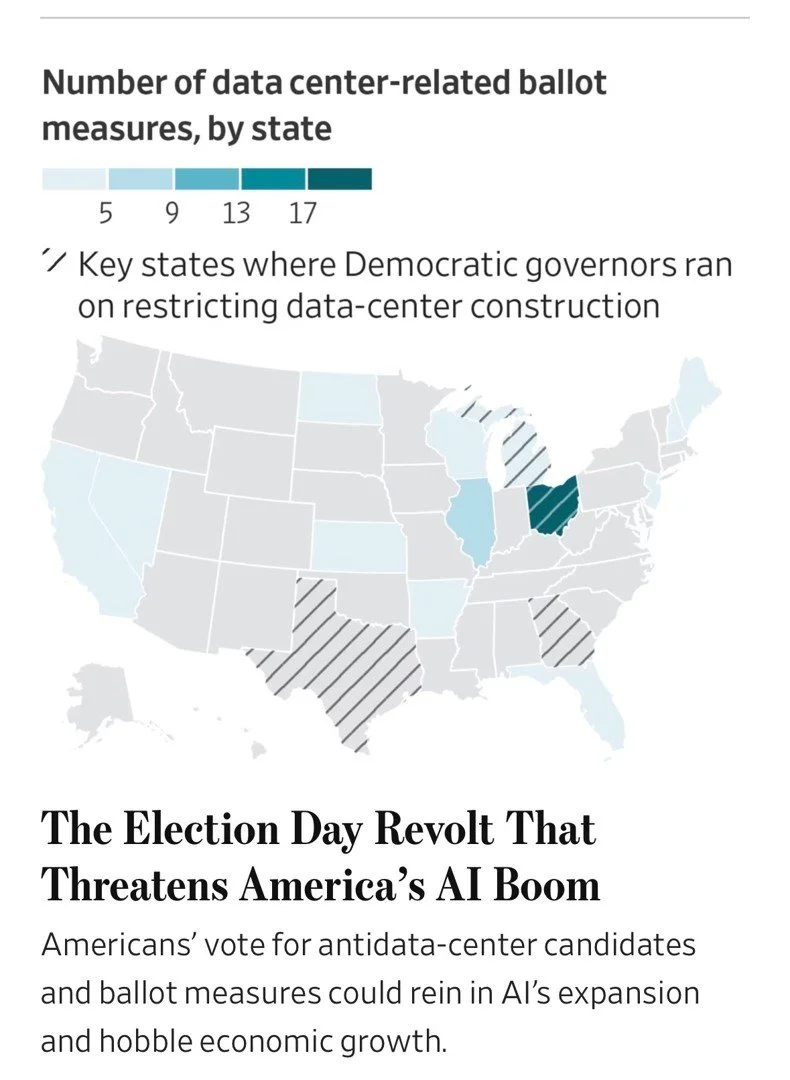
But let's be honest about a few things: (1) Doing my best to put politics aside, Democrats generally don't hate datacenters, rather they're in favor of thoughtful growth taking into consideration the impacts on energy bills and the environment. And truthfully, so are most Republicans. (2) Given American's addiction to smart phones and devices, we cannot reasonably hope to stop the AI megatrend. Rather, we can only hope to contain it for good. And (3) the election-related selloff and narrative is largely fear driven (not fundamentally driven) and it has created a lot of more attractive entry points for long-term AI stock investors, including Broadcom.
Valuation
From a valuation standpoint, Broadcom is increasingly attractive. As you can see in the following chart, the company has tremendous revenue growth trajectory and very strong net margins, yet trades at a forward P/E of only 15.2x (attractive) and a forward P/E to growth (or PEG ratio) of only 0.8x (also very attractive!).
Arguably, Broadcom deserves a premium for its growth, technology advantages, and strong cash generation. However, the market offers the shares at a discount relative to other leading semiconductor businesses and other top AI stocks, as I have discussed.
And if software sentiment improves while AI revenue compounds, Broadcom could benefit from both earnings growth and valuation re-rating (i.e. the shares have powerful upside potential).
Risks
However, rather than only considering the attractive qualities, investors should also consider the risk factors Broadcom is currently dealing with.
Customer Concentration: Broadcom faces significant customer concentration risk. Specifically, the Broadcom's AI growth depends significantly on a group of large customers, including Alphabet (GOOGL), Meta (META), OpenAI, and Anthropic. Any major spending changes by these companies (e.g. reduced orders and/or delayed datacenter deployments) could impact Broadcom meaningfully. According to disclosures, Broadcom’s top five end customers accounted for approximately 45% of net revenue in the first half of fiscal 2026.
Competition and in-house chip development: Nvidia (NVDA), Marvell (MRVL), and customers like Google are increasingly challenging Broadcom's custom-chip business. For example, customers are constantly working to develop more chips internally to reduce their reliance on Broadcom and thereby creating pricing/margin pressure.
Infrastructure and supply constraints: Particularly following the recent US elections, shortages of grid power and delays in datacenter construction/permitting could slow growth. Also, limited supply of advanced packaging and memory (think Micron (MU), Sandisk (SNDK) and SK hynix (SKHY)) could postpone AI deployments, pushing revenue into later quarters.
VMware licensing and customer retention: Broadcom's licensing changes and shift toward VMware Cloud Foundation bundles have frustrated many customers, potentially accelerating migrations to alternatives such as Nutanix, Microsoft Hyper-V, or open-source platforms. Nonetheless, VMware is a massively profitable business segment for Broadcom.
The Bottom Line
Despite powerful AI momentum, Broadcom shares have underperformed most other chip stocks over the last year—arguably an inappropriate penalty for its large VMware software business (the market has been selling software in favor of disruptive AI, as discussed).
And more recently, the US elections have created another fearful narrative that datacenter growth will be halted by new regulations (likely another dramatically overblown fear, as discussed).
Realistically, both fearful narratives have contributed to Broadcom shares trading at a discount relative to its value and growth trajectory. More specifically, Broadcom's underperformance and selloff is a gift to long-term growth investors.
*Long Broadcom (and it is ranked in our new report: Top 10 AI Growth Stocks On Sale).