
Palantir: The IBM Of AI
Palantir increasingly looks like the IBM of AI—and that’s intended to be a compliment. For example, it is a dominant technology infrastructure positioned at the center of a generational shift (AI), just like IBM dominated the mainframe era (and became mission critical for governments and large corporations). IBM enjoyed an extraordinary long-term run (it was once the largest company in the world)—and Palantir may still be in the early innings of its own generational run. This report reviews Palantir’s business, competitive advantages, growth trajectory, valuation and risks, and then concludes with a strong opinion on investing.
About Palantir
Palantir develops software to help governments and enterprises integrate big data and deploy artificial intelligence. Its Gotham, Foundry and AIP platforms increasingly function as an operating layer connecting proprietary data and business processes with AI models and human decision-making.
And CEO, Alex Karp, argues that Palantir's model is fundamentally different from companies monetizing AI through usage:
“We are paid, and have always aspired to be paid, as a derivative of value creation,”
Karp said in the most recent shareholder letter. He believes customers increasingly want to retain control of their proprietary information rather than effectively becoming “vassal states of the language labs.”
Competitive Advantage
Palantir's competitive advantage is not just its access to AI models, but also the combination of data integration, ontology (i.e. mapping how an organization’s data connects), security, AI agents, and solution-oriented engineers (i.e. engineers who work directly with customers to solve problems).
And just like IBM’s mainframes became deeply embedded in critical enterprise and government infrastructure, Palantir is attempting to establish the equivalent position for AI.
Growth Trajectory
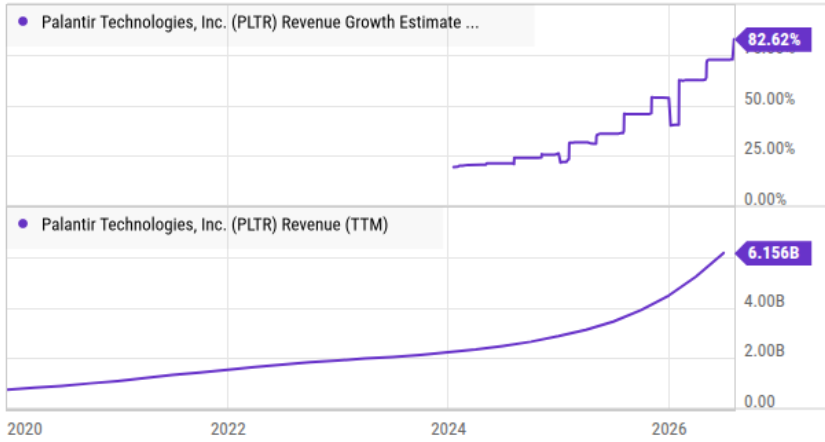
As per Palantir’s latest quarterly earnings release, the company's growth is increasingly driven by commercial AI adoption rather than just government contracts. For example, US commercial revenue rose 149% year-over-year in Q2, while U.S. commercial bookings reached $2.13 billion (up 153%). And amazingly, “net dollar retention” reached 157%, demonstrating significant expansion within the existing customer base.
Valuation
When it comes to valuating Palantir shares, there are usually two diametrically opposed camps. On the one hand, there are the investors who care only about the forward-looking growth story. And on the other hand, there are the investors that focus almost entirely on traditional valuation metrics.
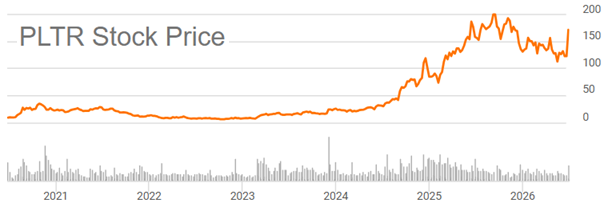
To put this debate into some perspective, on traditional valuation metrics, Palantir is one of the most insanely overpriced stocks you will ever see, currently trading at 71x sales and 147x earnings (as you can see in the chart below). These are not just nosebleed valuation levels, they are SpaceX mission to Mars levels (i.e. the S&P 500 trades at 3.6x sales and 29x earnings—which is high in its own right by historical standards).
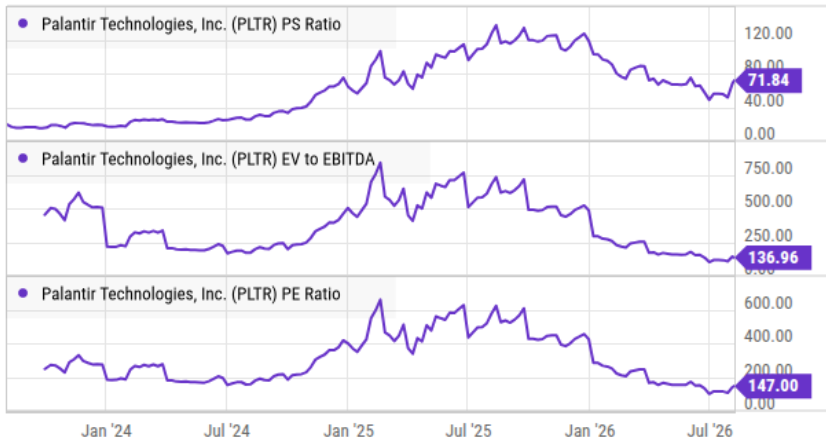
On the other hand, are the Palantir investors who couldn’t care less about valuation metrics—they just see the extraordinary growth and believe in the AI big-data growth story—no matter what. Honestly, these are mostly the young Robinhood crowd—they can absolutely “vote” shares dramatically higher in the short-term, but in the long-term Palantir needs to keep generating extraordinary rocket ship growth for the next decade for the current valuation to even make sense.
Palantir is not priced like a conventional company. Investors are effectively paying for years of rapid growth, exceptional margins and the possibility that AIP becomes a foundational enterprise AI platform.
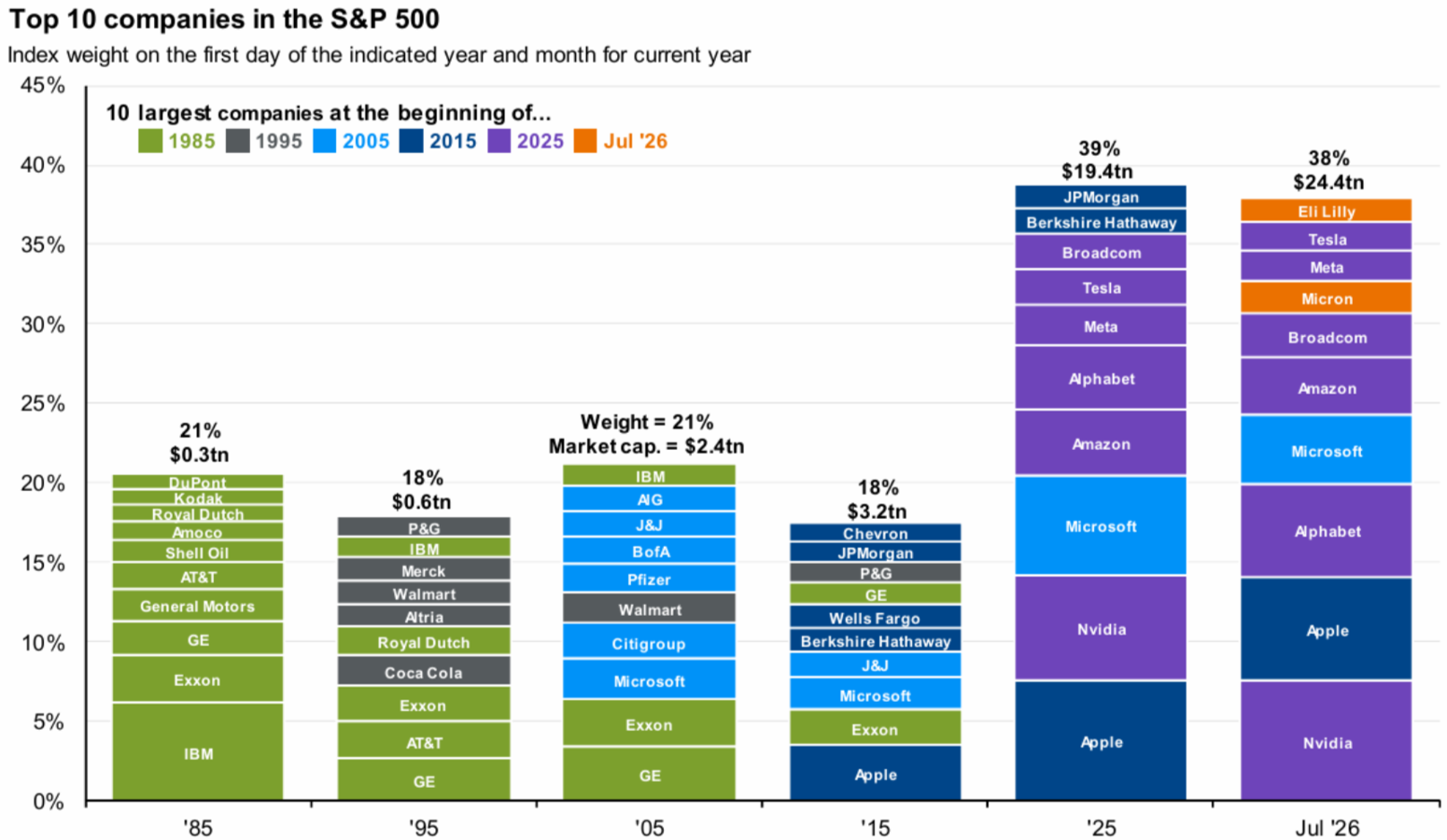
For a little more perspective, the following chart shows IBM was the largest company in the S&P 500 in 1985, representing roughly 6% of the index. Palantir isn’t the largest company in the S&P 500 yet (it’s currently around 0.5% of the S&P 500)—but it has the potential to become one of the largest (perhaps a top 10). But the challenge is now whether Palantir can generate the decade of rocket-ship growth the market is already pricing in—before it gives way to some new technology—just like what eventually happened to IBM.
Risks
In addition to an ultra-high valuation, Palantir faces a variety of additional risks. For example, its foundation models could become increasingly commoditized, and so could elements of the AI application and orchestration layer. For perspective, the likes of Microsoft, Google, Amazon and a lot of additional software vendors have enormous resources to keep competing and attempting to weaken Palantir’s strong position.
Also, Palantir must continually evolve its platform as AI architectures change. If the industry moves toward a new architecture that bypasses AIP, today's competitive advantages could weaken rapidly.
The Bottom Line
Comparing Palantir to IBM is intended to be a compliment with a warning attached. IBM demonstrated how a technology company can become deeply embedded in the global economy and generate enormous shareholder value over an extended period. Palantir could follow a similar trajectory as AI becomes a mission-critical layer for government and enterprise infrastructure.
However, IBM also demonstrates that being the dominant company of one technology era does not guarantee dominance in the next (and IBM is no where close to being the biggest market cap company today—in fact it’s $220B, Palantir is $375B, and Nvidia, for perspective, is $5.3T).
The question is can Palantir deliver on all the growth baked into the share price before that next big technology shift comes (which may be decades away before AI eventually slows and/or is displaced).
I would consider adding a 0.5%-ish position in Palantir (its weight in the S&P 500), but I couldn’t bring myself to investing in a much larger position than that considering the ultra-high valuation.
Congrats if you were long Palantir over the last week (it’s up sharply after earnings).
*No position in PLTR.