
Nvidia: 5 AI Stocks Down Big (Relative to Earnings)
The internet bubble may have burst in the early 2000’s, but the internet didn’t die. Rather, it kept getting bigger for decades, and the leading companies harnessing it made a lot of money for their shareholders. Similarly, the current AI megatrend will produce enormous winners and losers, and the irony is the leading AI companies—with the most powerful earnings growth trajectories—are actually getting LESS expensive (on a fundamental valuation basis). This report reviews Nvidia (NVDA), plus four more leading AI stocks that are ironically getting less expensive (relative to their powerful earnings growth) and then concludes with a strong opinion on how to invest at this current point in the raging AI megatrend.
Nvidia Overview
Nvidia is basically ground zero for the AI megatrend. It’s the largest stock by market cap (over $5T), and its leading GPU chips basically enabled the AI megatrend to begin (by providing massive parallel computing power and thereby enabling the practical training of large “neural networks”).
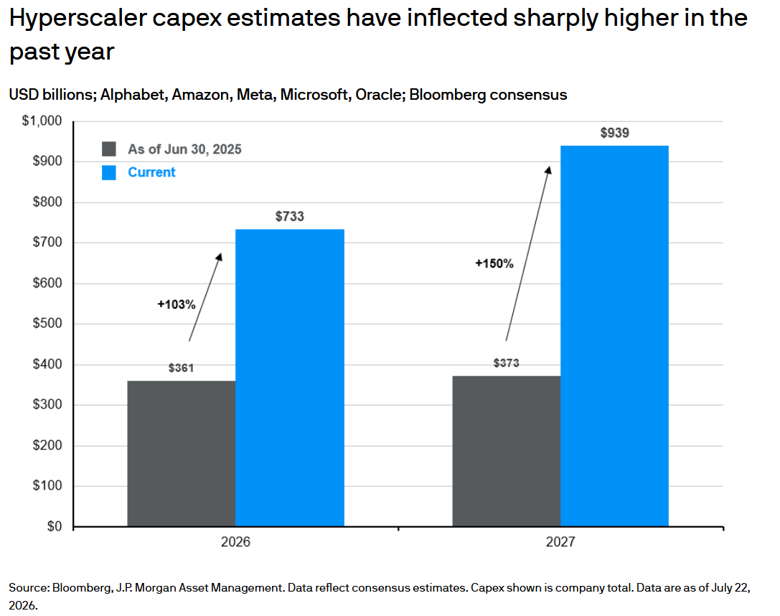
Nvidia’s AI chips are accelerating some industries (for example, hyperscaler spending on AI is unprecedented in modern history, see chart below), data center suppliers are growing like rocket ships (for example, we’ll share data on several later in this report), and legacy industries like Software-as-a-Service continue to take a volatile beating (as hedge funds like Situational Awareness bet they’ll be displaced by AI).
What’s more, Nvidia is expanding beyond GPUs. For example, the company increasingly sells entire “AI factories,” including chips, networking, and systems (and thereby raising its share of customers total AI spending).
Further still, CEO Jensen Huang believes “compute” is so critical that it should become an investable asset class. For example, he believes Nvidia systems’ durability and cash-generation potential could support asset-backed financing, expanding customers’ ability to fund deployments (in case anyone was afraid AI capex might slow).
AI Market Opportunity and Trajectory
To put some perspective around AI infrastructure demand, Huang believes global AI infrastructure spending will reach $3T-$4T through 2030. That’s a lot considering most of it comes from the hyperscalers (see earlier chart, above) and they are not there yet, but they are accelerating fast.
He is also confident Nvidia can grow its revenue by 70% next year. This is mind-blowing considering it’s already the largest company by market cap in the world. However, it’s also important to note that use cases are continuing to ramp significantly, with cybersecurity positioned as one of the next major applications, and then physical AI/robotics emerging next.
Nvidia’s Valuation
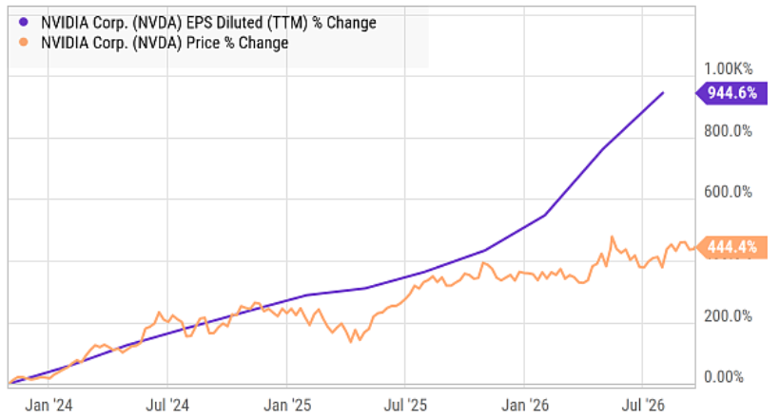
One of the most ironical things about Nvidia’s incredible position at the base of the entire AI revolution is that despite its incredible ongoing growth trajectory (again, Huang remains confident it can growth revenues by ~70% next year, and net margins are extraordinary—more on this momentarily) is that the shares just keep getting less expensive relative to earnings.
And as you can see in the graphic below (which includes Nvidia and a few more stocks we’ll consider later in this report), Nvidia has a variety of extraordinarily impressive metrics worth considering, including its sub-1.0 forward PEG ratio (price-earnings to growth), the shares have 53% upside (per the 49 Wall Street analysts covering the company), and its forward price-to-earnings ratio is even dramatically lower than its trailing-12-month P/E (attractive!).
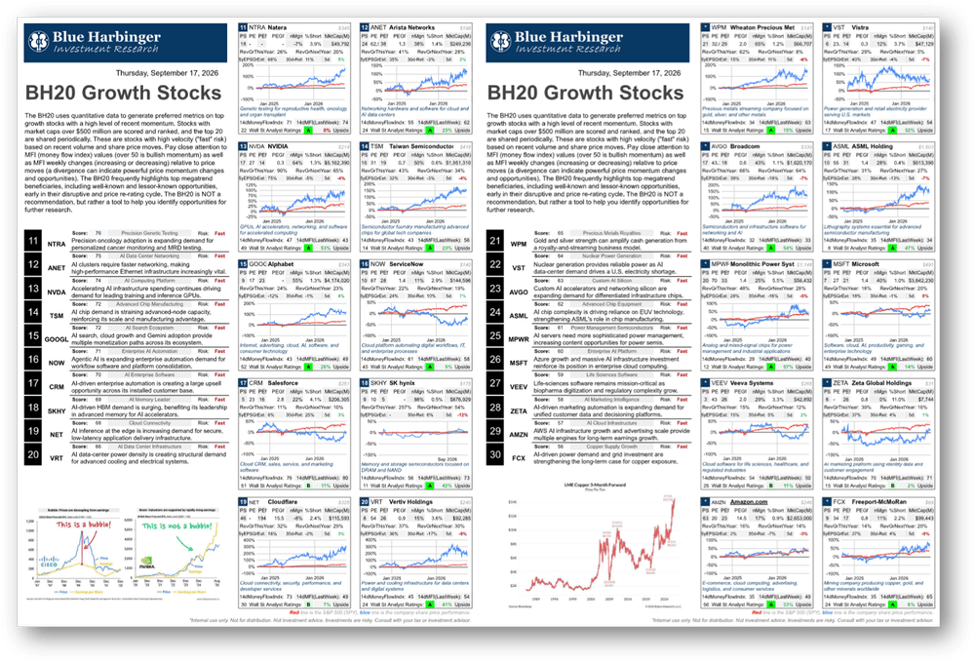
Click the image to launch a zoom-in-able PDF version.
From a fundamental valuation standpoint, Nvidia has just about everything you could ask for, including low valuation metrics, high growth trajectory, impressive moats (both CUDA software and that fact that its AI chips are the wide favorite around the globe), and a massive total addressable market (as the opportunity across the economy is enormous and growing).
Nvidia and AI Megatrend Risks
So when it seems everyone is bullish about the same thing (i.e. Nvidia) that’s usually a good time to at least consider the contrarian view and the risks. So here are a few:
Competition: Multiple companies are having increasing success with their own AI chips, including large Nvidia customers such as Amazon (Trainium3), Meta (MITA), and Alphabet (Tensor), as well as pure semiconductor businesses like AMD (Ryzen) and Intel (Core Ultra) to name a few. However, none of them can really compete with Nvidia in terms of hardware excellence, software (CUDA) ecosystem maturity, and strategic infrastructure integration. What’s more, the AI opportunity is so large that there is room for multiple winners.
Supply constraints are a key bottleneck that could impact Nvidia’s growth, such as components, power, land and data-center capacity. However, the reality is this is a high-class problem because it means there is more demand than supply (the backlog is a good thing) and limited supply increases pricing power for Nvidia. Plus, Huang just recently said “I expect Nvidia to sell twice as many chips as this next year as we do this year.”
Geopolitical and Regulatory Constraints are another big one. For example, the US restricts Nvidia GPU sales to China for national security reasons, and Chinese policies favor domestic alternatives too. Further, Nvidia relies on Taiwan Semiconductor (TSM) to produce nearly all leading-edge Nvidia chips—which is a huge risk considering China’s views on Taiwan.
4 More AI Stocks Down Big Vs. Earnings
So with that Nvidia backdrop in mind, it’s worth considering a few more top AI stocks that are down big relative to earnings on a valuation basis, such as the names in this next chart (including Microsoft (MSFT), Alphabet (GOOGL), Amazon (AMZN), and Salesforce (CRM)). As you can see, all of the stocks in the table below have experienced Earnings Per Share (EPS) growth much faster (and more significantly) than price appreciation growth.
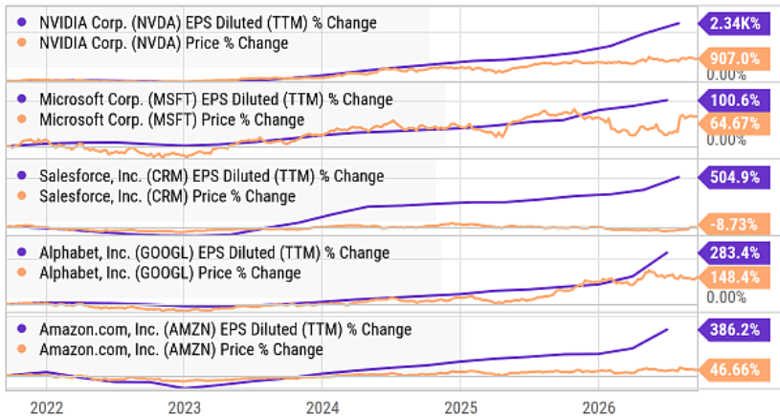
Now you may be thinking “why should I care?” about these mega-cap names when there are much faster growing AI stocks (including a handful of them in the earlier 20-stock graphic, which shows specific AI stocks with higher revenue growth expectations for both this year and next). However, one of the big differences is the valuation metrics for the mega caps in the chart above are getting more attractive (while many of the fastest growing AI stocks have valuation metrics that are getting less attractive).
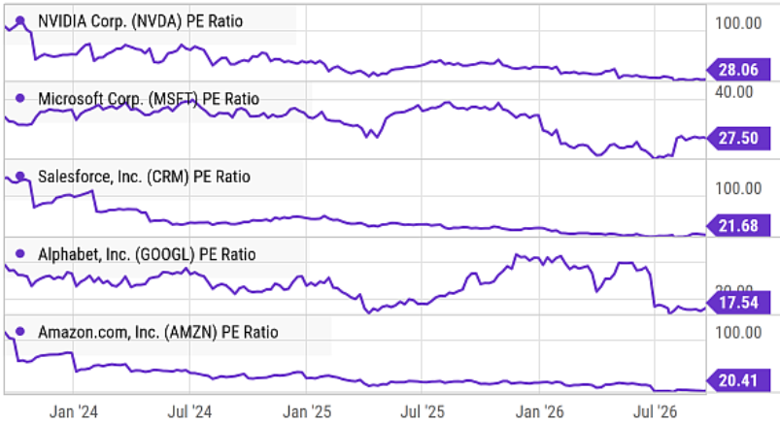
What’s more, the mega caps in the chart above have durable economic moats, as described below.
Microsoft (MSFT)
Microsoft (a company with a higher credit rating than the US government) is benefiting from AI being increasingly embedded across its businesses, including Azure, Microsoft 365 Copilot, GitHub Copilot, and Dynamics. Yet as its revenue rises as a result (as of FY2026 year-end, Azure had surpassed $100 billion in annual revenue and Microsoft 365 Copilot had more than 30 million paid seats) its valuation continues to decline (i.e. its P/E ratio, for example, has fallen as you can see in the chart above—because the share price hasn’t been keeping pace with earnings growth (i.e. an attractive valuation)).
What’s more, Microsoft has durable moats (which many smaller AI companies do not) including its enormous enterprise distribution, high switching costs (from deeply integrated software stacks), a massive developer ecosystem, a trusted security/compliance infrastructure, and the scale required to operate a global cloud infrastructure (Azure)).
And as a particularly encouraging recent development, Azure grew 43% last quarter while demand continues to exceed available capacity (giving the company both pricing power and a long runway of foreseeable growth).
Salesforce (CRM)
A lot of people view Salesforce as a legacy software platform that will be totally displaced by newer, better, cheaper software solutions developed by AI. However, AI is being layered into CRM’s existing platform through Agentforce (and thereby increasing the value of the business). Yet the stock price is staying basically flat in recent years while the earnings continues to accelerate (i.e. the valuation is attractive).
Further, the company has attractive moats (such as deeply embedded customers, data, high switching costs, and a wide ecosystem) that cannot easily be displaced by AI or anyone else for that matter.
To be clear, Salesforce earnings has continued to grow dramatically, but its share price has not (see earlier chart). Said differently, Salesforce isn’t so much a legacy business that will be displaced by AI, but more of leading high-moat business than will benefit from AI.
Alphabet (GOOGL)
Alphabet (the owner of Google, YouTube, Android, Google Cloud, and a large portfolio of internet products) is benefiting from AI across virtually every layer of its business. Yet its share price is not keeping pace with its earnings growth.
For perspective, Google’s Gemini AI is enhancing Search (and consumer products), AI tools are increasing Google Cloud demand, and Alphabet's internally developed TPUs and full-stack infrastructure allow it to capture economics from both AI models and the underlying compute.
And Alphabet’s valuation is even more attractive considering it has powerful moats (such as leading search, distribution scale via Chrome, data , machine-learning, Android, an enormous YouTube audience, and incredible network effects in advertising, to name a few). Alphabet’s valuation is attractive.
Amazon (AMZN)
AI continues to drive dramatic improvement in Amazon’s revenues and earnings, yet the share price is not keeping pace (i.e. the shares are undervalued)
For example, Amazon is still the largest cloud service provider (ahead of Microsoft and Google), and AI is ramping the pace of cloud demand dramatically. Amazon is also the world’s largest ecommerce platform contributing to its vast ecosystem and data. d
Furhter still, Amazon’s business has durable moats (including its enormous fulfillment infrastructure, wide ecosystem, and high switching costs).
Amazon shares have risen in price, but not as fast as its earnings are growing, and this makes for an attractive investment opportunity especially considering the strong moats and continued long runway for high growth from AI.
The Bottom-Line
Ironically, many (but not all) of the hottest AI stocks right now (i.e. the ones trading at nosebleed valuations) will come crashing down hard and/or just fade away as the industry shifts (similar to what we saw for many top stocks during the Internet Bubble)—while some of the most dominant AI leaders (with some of the most impressive earnings growth trajectories and competitive moats) are currently trading at attractively low valuation metrics (relative to earnings growth), such as the ones listed in this report.
At this point in time, investing in AI may or may not be right for you, but if you are a long-term investor (willing to accept a higher level of volatility in the quarters and years ahead), there are currently some extremely compelling valuations and opportunities out there (and many of them are sitting right underneath your nose).
Be smart people. Do what is right for you.
*(Long Nvidia, Microsoft, Alphabet, Salesforce and Amazon in the BH LTCA Portfolio).