
PFFA: Tempting 10%+ Yield Preferred ETF, Despite Risks
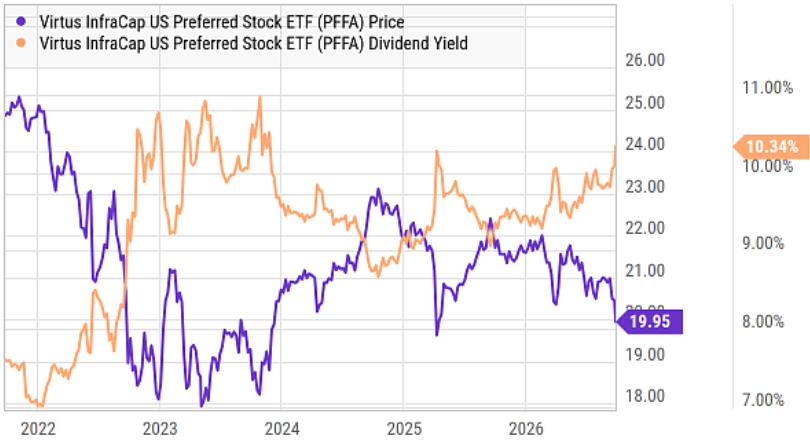
If you are an income-focused investor, the Virtus InfraCap US Preferred Stock ETF (PFFA) is particularly tempting right now. In particular, interest rates have risen, causing the PFFA share price to fall and the big monthly distribution yield to mathematically rise to over 10.3%. However, before you dive in headfirst, this report reviews the strategy's additional benefits (including active security selection, sector rotation, "modest" leverage, and an emphasis on maximizing yield-to-call, to name a few), as well as the big risks. After reviewing the strategy in detail, this report concludes with a strong opinion on investing.


Virtus InfraCap US Preferred Stock ETF
(PFFA), Yield: 10.3%
The Virtus InfraCap US Preferred Stock ETF (PFFA) seeks current income as its primary objective and capital appreciation as its secondary objective. It does this by investing in primarily preferred securities issued by US companies with market caps above $100 million. And unlike a passive preferred-stock index funds (such as PFF) , PFFA is actively managed.
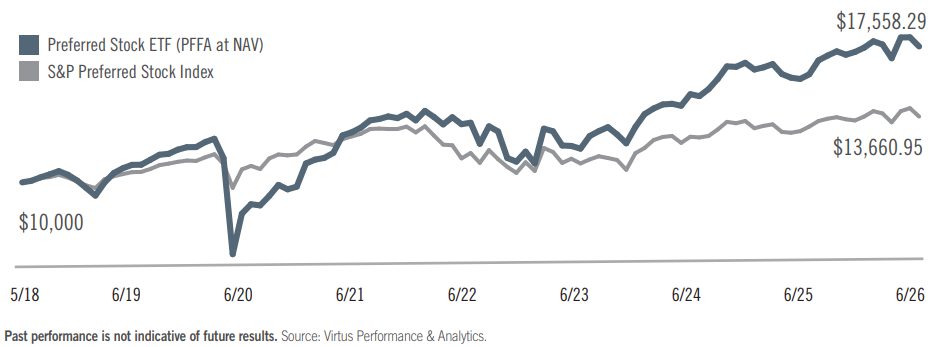
Specifically, PFFA’s portfolio managers evaluate companies' competitive positions, profitability, cash generation, access to capital, credit characteristics, valuation, and yield-to-call. Additionally, the strategy uses options (opportunistically) and leverage (typically 20–30% of NAV) to increase the current income paid to investors.
The fund’s yield is currently 10.3%—extremely tempting compared to other income opportunities (but there are risks—as will be covered later in this report).
How Preferred Shares Work
For an overview, preferred shares are technically considered equity, but economically they resembles a hybrid of stocks and bonds. For example, preferred shareholders have priority over common stock shareholders in terms of dividends and in the case of a company failure and liquidation. However, preferred shares remain subordinate to corporate debt (e.g. bonds).
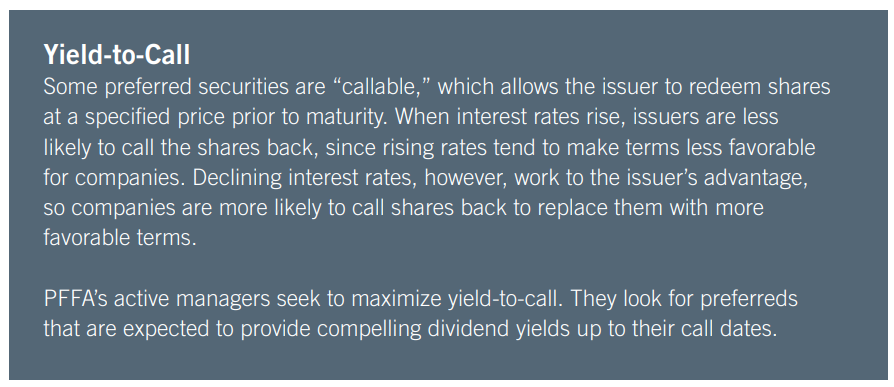
Additionally, many preferred shares are callable, meaning the issuer can redeem them—often at $25—after a specified date. Consequently, investors must consider not only the stated dividend yield but also the potential return if the security is called. PFFA's active management specifically seeks to exploit these yield-to-call differences.
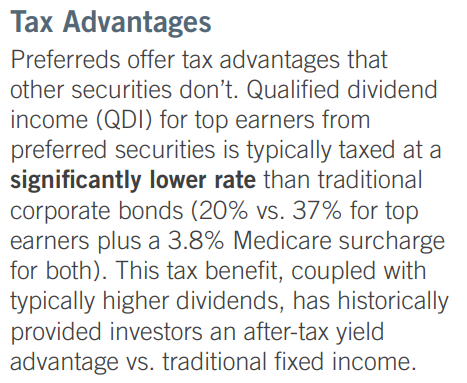
Also worth mentioning, there can be tax advantages with preferred share dividends when they are qualified, which they often are, as explained in the following graphic from PFFA’s fact sheet.
The Big Risks
Before investing in PFFA simply for its big yield (which is paid monthly), investors should also consider the big risks, such as those described below.
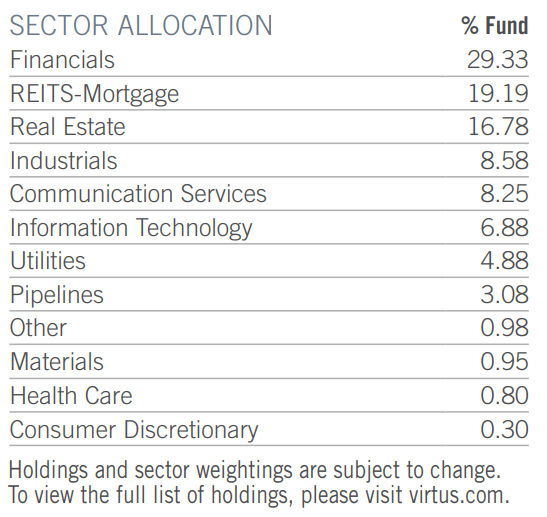
Sector concentration. For starters, PFFA is a non-diversified fund, and its active strategy can produce substantial sector tilts. For example, real estate has historically been an important allocation. For example, 16.7% of the fund was recently invested in real estate—versus only 6.8% for its preferred stock benchmark. Its portfolio can also have meaningful exposure to financials, energy, industrials, utilities, and other cyclical sectors, as you can see in the current sector allocation table below.
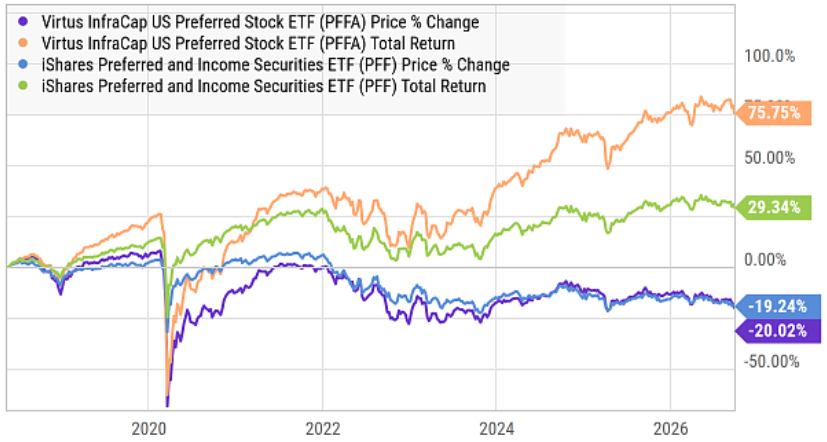
Leverage. PFFA uses leverage (i.e. borrowed money) to magnify income and potential returns. This is a strategy that works well when the market is strong, but it can also magnify losses (and force the fund to reduce positions) if/when the market turns south. The Covid pandemic illustrated this risk in March 2020 when PFFA reduced leverage and lowered its distribution because preferred-stock prices collapsed and market conditions deteriorated (see earlier returns chart).
NAV versus market price. Most ETF shares normally trade close to NAV (net asset value), but severe market stress can cause substantial temporary deviations, particularly for PFFA. For example, during March 2020, PFFA experienced unprecedented NAV/market-price dislocations as underlying securities became extremely illiquid (PFFA’s outsized allocation to real estate securities magnified the problem as that sector was particularly hard hit by Covid lockdowns). PFFA's underlying preferred securities were especially vulnerable to this phenomenon (and this is a risk investors need to keep in mind if they are going to invest).
Credit Risk. Credit risk is arguably the most important risk to understand. Preferred shareholders stand behind creditors, so deterioration in an issuer's financial condition can cause both falling prices and suspended dividends. And real estate and mortgage-related issuers (a huge sector exposure for PFFA) can be particularly sensitive to market conditions (i.e. a large price decline does not require widespread defaults). For example, during the Covid pandemic in 2020, credit spreads and liquidity premiums exploded even as the Federal Reserve drove short-term interest rates toward zero. This is a perfect example of how PFFA should NOT be considered a low-risk bond substitute.
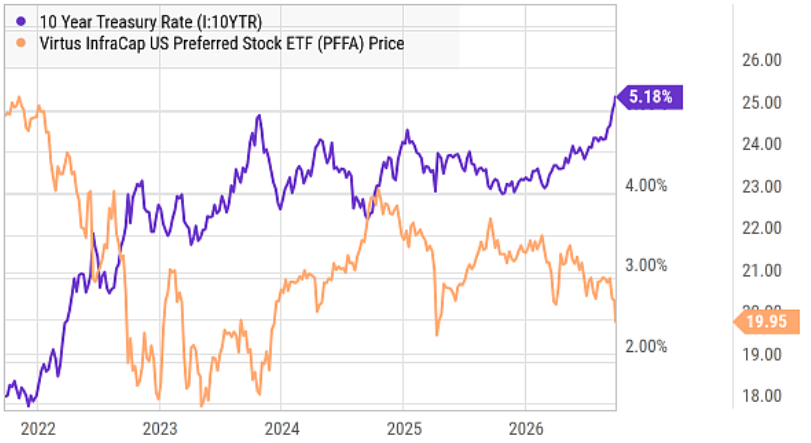
Interest-Rate Risk. Preferred shares can also be particularly sensitive to interest rates—specifically because many preferreds pay fixed dividends and have long or effectively perpetual maturities. Rising rates can therefore reduce their relative attractiveness and prices. In fact, this is what's going on right now with interest rates rising and PFFA's share price falling (see chart below).
However, PFFA's exposure is more nuanced than that of a conventional long-duration bond fund because many preferreds have floating or fixed-to-floating structures, and active management can emphasize securities with more favorable rate characteristics. For perspective, PFFA has dramatically increased the portion of fixed-to-floating-rate preferreds during some historical periods.
Distribution Sources. Also worth noting, not all of PFFA’s distribution is sourced from dividends and or interest on preferred shares and other holdings. In fact, as you can see in the chart below, PFFA has recently sourced a portion of the distribution through a “Return of Capital.”
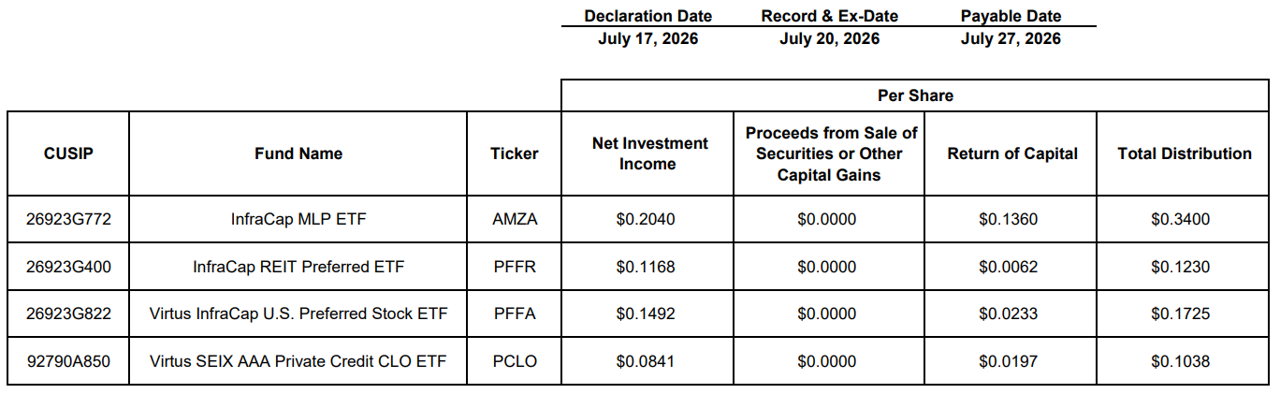
Returning your own capital to source a portion of the distribution is fine from time to time, but over extended periods of time in can weaken the fund’s NAV and income-generation power. Overall, PFFA has delivered strong monthly income throughout its history, as you can see in the table below.
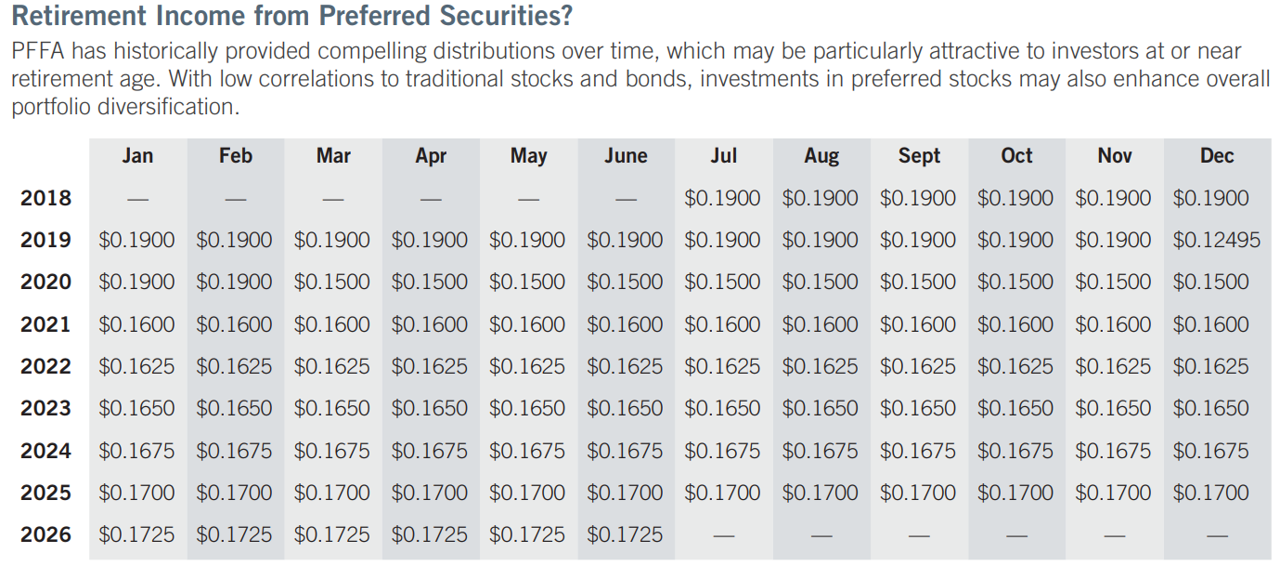
Fees and Expenses. PFFA's expense ratio is relatively high for an ETF, reflecting active management costs and the funds somewhat small $2.5B assets under management. The fund's published fact sheet reports a 2.1% total expense ratio, including a 0.8% management fee. And in addition to typical expenses, PFFA investors bear the economic cost of the fund's leverage through its financing arrangements. These costs reduce the benefit of leverage and become particularly important when borrowing costs rise or the spread between portfolio yields and financing costs narrows (something to keep on your radar).
The Bottom Line
If you like big steady income, PFFA offers some very attractive qualities, but big risks too.
From an attractive-qualities standpoint, PFFA offers big steady monthly distributions, and some important diversification benefits versus traditional common stocks and bonds. And its active management strategy provides the potential for further benefits (through security selection and managing call risks, to name a couple).
However, PFFA comes with big risks too, such as meaningful credit, liquidity, interest-rate, concentration, and leverage risks. And as a standalone investment (or even as a large allocation in an income-focused portfolio), PFFA is quite risky.
Yet used in moderation (alongside prudently diversified bonds, equities, and other income-producing assets), PFFA is absolutely worth considering. In fact, if you are a high-income-focused investor, you’d be remiss to not at least consider a small allocation to PFFA—especially as rising rates have decreased its price and increased the monthly distribution yield available to new investors.
Be smart people. Do what is right for you.